


A total of 26 isolates (cases) of C. auris have been reported in the Netherlands, from first appearance in 2018 to 2025; two cases were invasive infections, while the remaining twenty-four cases were regarded as colonisation. All were imported cases.
Since the first report of C. auris in the Netherlands, an upward trend in the number of cases have been observed over the years, with one to two cases reported annually, between 2018 and 2022, and an increased incidence in 2023 and 2024, with six and eleven cases respectively. In the first three months of 2025, two cases were reported.
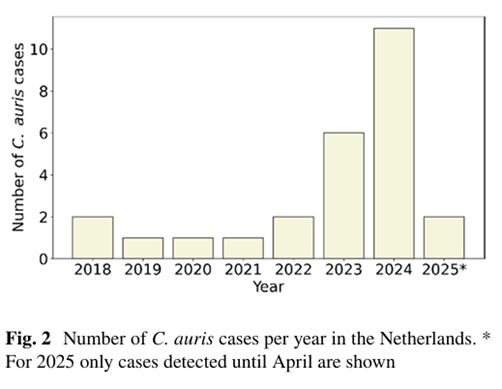
Chiara C de Groot and colleagues report the epidemiological overview in the Netherlands in a study, and clearly demonstrate that effective infection control practices and policies are effective at preventing nosocomial transmission. All patients were admitted to single room isolation, and all but one remained there for the duration of their hospitalisation. All cases were proven to be non-nosocomially transmitted but rather imported from other countries. Their data from whole genomic sequencing of isolates, available travel history and information on contact tracing showed patients (cases) had recently travelled internationally, and all but one had been admitted to a foreign hospital. Frequent travel destinations included Greece, India, Turkey and South Africa, countries known to have a high prevalence of C. auris.
Identification was done through culture-based methods and species confirmed by Matrix Assisted Laser Desorption Ionization-Time of Flight Mass Spectrometry (MALDI-TOF MS) (Bruker, Bremen, Germany). Whole genome sequencing showed isolates belonged to clade I or III. Overall, all the C. auris isolates showed reduced susceptibility to fluconazole and a case each of elevated MICs against flucytosine and the echinocandins, including rezafungin.
However, as the number of C. auris cases continue to rise, an outbreak may occur, which underscores the importance of maintaining robust surveillance and infection prevention measures to prevent potential outbreaks or enable a rapid, effective response if they occur.